
🏛️ The island’s history
654 BC · The Phoenicians found Ibiza
Coming from today’s Lebanon, they found a trading port called Ibosim, “the island of Bes”: the Egyptian-Phoenician god of music and dance. The party island has carried the name of the god of dance for 2,600 years.
Romans · Ebusus
Under Rome the island is called Ebusus and becomes a naval and trading base in the Mediterranean.
902 – 1235 · Yabisa, Arab Ibiza
For over three centuries the island is Arab: the terraces, wells and water wheels still seen in the countryside come from this time. In 1235 the Catalans conquer it, which is why its official name today is Eivissa.
1500s · The walls of Dalt Vila
The Renaissance walls of the old town were built against pirates and the Ottomans and are still intact: the best-preserved coastal fortress in the Mediterranean.
1999 · UNESCO World Heritage
On 4 December 1999 UNESCO protected four treasures together: the walls of Dalt Vila, the Phoenician necropolis of Puig des Molins, the Ses Salines salt flats and the underwater Posidonia meadows.
1960s · The hippies arrive
Artists, writers and young people from all over the world (including Americans avoiding the Vietnam draft) discover a poor, free and beautiful island. The spirit of Ibiza is born.
1973 & 1985 · The hippy markets
In 1973 the Punta Arabí hotel near Es Canar invites hippies to sell their crafts: the first market is born. On 14 February 1985 Las Dalias opens in Sant Carles with 5 stalls: today there are over 300 on Saturdays.
🎧 How the clubs were born
1973 · Pacha
Brothers Ricardo and Piti Urgell (who had opened a Pacha in Sitges in 1967) open in an Ibizan farmhouse facing the port. The name comes from a joke: “with the money you’ll make, you’ll live like a pasha”. The two cherries become the most famous logo of the night.
1976 · Amnesia
Antonio Escohotado rents an 18th-century farmhouse for 20,000 pesetas a month (about €120). The name comes from Greek: “the workshop of forgetfulness”.
1979 → 1995 · Ku, then Privilege
It starts as a restaurant with a pool; footballer José Antonio Santamaría turns it into Ku. Since 1995 it is Privilege, in the Guinness World Records as the world’s largest nightclub: 10,000 people on 6,500 m².
20 June 1980 · Café del Mar
It opens on Caló des Moro bay in Sant Antoni: chill-out music to listen to at sunset is born here, and the sunset ritual becomes world famous.
1987 · The summer that changed music
At Amnesia Argentine DJ Alfredo mixes pop, soul, funk and the new American house: the “Balearic beat”. Four English DJs (Paul Oakenfold, Danny Rampling, Nicky Holloway and Trevor Fung) hear it, go back to London and open Shoom and Spectrum: acid house and European rave culture are born.
1986 → 2017 · Space, then Hï Ibiza
Space in Playa d’en Bossa, famous for daytime parties and Carl Cox, closed in 2016. Since 28 May 2017 Hï Ibiza stands in its place.
1999 · DC10 & Circoloco
A small bar near the airport licensed for 80 people: two Italian promoters create the Monday Circoloco party, an underground legend.
2011 · Ushuaïa
Abel Matutes and Yann Pissenem invent the open-air hotel-club in Playa d’en Bossa: dancing by the pool, in daylight.
✨ Curiosities
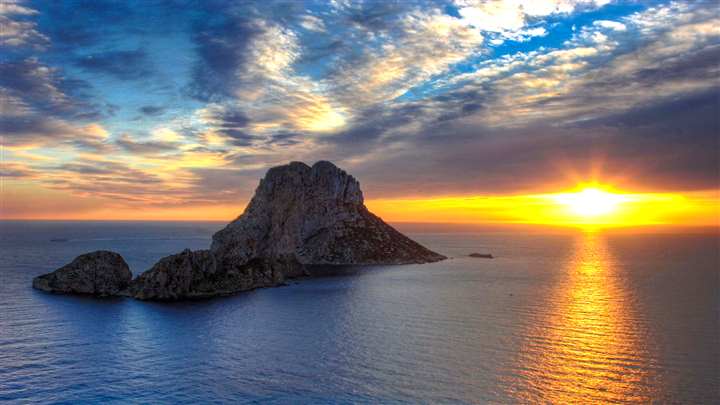
Es Vedrà · The “magic” island
It is said to be the sirens’ island from the Odyssey, the tip of Atlantis and one of the most magnetic points on Earth. In reality it is limestone with no measured magnetism — but the sunset from Cala d’Hort really is magic.
Sargantana · The symbol lizard
The Ibiza wall lizard (Podarcis pityusensis) lives only here and on Formentera. It is endangered by snakes that arrived with ornamental plants: if you see one, leave it alone.
Posidonia · The secret of the clear water
The Posidonia meadows between Ibiza and Formentera filter the sea and produce oxygen: that is why the water is so clear. They are UNESCO-protected: do not anchor on them.
Ses Salines · White gold
Ibiza salt has been produced since Phoenician times and for centuries was the island’s wealth. Much of it is still exported to Northern Europe today.
Tanit · The island’s goddess
The Phoenician goddess Tanit, of the moon and fertility, is still a symbol of Ibiza: you’ll find her on pendants and souvenirs in every market.
Sources: UNESCO – Ibiza, Biodiversity and Culture · Dalt Vila – history · Wikipedia – Pacha Group · Wikipedia – Amnesia · Wikipedia – Privilege Ibiza · Wikipedia – Space / Hï Ibiza · Wikipedia – DC10 · Wikipedia – Balearic beat · Café del Mar – about · Wikipedia – Ushuaïa Ibiza · Wikipedia – Es Vedrà · Wikipedia – Ibiza wall lizard · Ibiza.travel – Salt, Ibiza’s white gold
Map, sat-nav, tonight’s parties, coves and clubs in your pocket. Free, no sign-up, in 79 languages.
Open the free guide